
ASIC mining is more competitive today than it was a few years ago. Buying a miner is only the first step. The real challenge is keeping that miner profitable while electricity costs, network difficulty, hardware efficiency, and cooling demands continue to change.
Many miners still focus on the purchase price of an ASIC miner, but the real cost of staying competitive goes much deeper. A cheaper machine can become expensive if it uses too much power. A powerful miner can underperform if cooling is poor. A profitable setup can quickly weaken if electricity rates rise.
At AsicProfit, miners can compare ASIC miners, estimate electricity costs, and calculate ROI before making decisions.
Why Competition Is Getting Tougher
Mining rewards are shared across the network. As more miners join, competition increases. This means each miner needs to operate more efficiently to protect profitability.
Today, the most competitive miners usually have three advantages: efficient hardware, low electricity costs, and stable uptime. Without those, even a strong ASIC miner can struggle to produce meaningful profit.
Miner Sample Comparison
Here are sample ASIC miner categories to show how efficiency affects competitiveness:
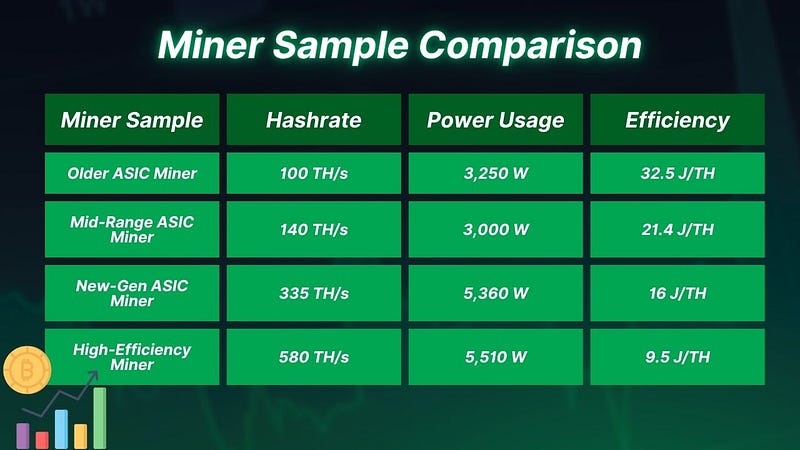
The table shows why efficiency matters. A miner with higher hashrate is not always better if it consumes too much electricity. The best setup balances power, output, and operating cost.
Electricity Cost Can Decide Profitability
Electricity is usually the largest ongoing cost in ASIC mining. A 5.5 kW miner running 24/7 uses about 132 kWh per day. At $0.06/kWh, that costs around $238 per month. At $0.10/kWh, the same miner costs about $396 per month.
That difference is nearly $1,900 per year for one miner. If a miner is running five machines, the yearly difference can approach $9,500.
This is why miners should calculate power costs before buying hardware or scaling operations.
Calculate your mining cost here:
https://asicprofit.com/calculator
Cooling Is Part of the Cost
Staying competitive also means keeping miners stable. ASIC miners produce heavy heat, and poor cooling can reduce performance. When miners overheat, they may throttle, lose hashrate, or wear out parts faster.
Cooling costs may include better fans, ventilation, facility upgrades, hydro setups, or professional hosting. These costs are easy to forget, but they directly affect real profit.
ROI Matters More Than Hype
New miner releases often look exciting, but miners should always ask one question first: how long will it take to recover the investment?
A miner with strong daily revenue may still be risky if the purchase price is high, electricity cost is expensive, or network difficulty keeps rising. ROI gives miners a clearer view of whether the setup makes sense.
Before buying, compare:
- Hardware price
- Daily net profit
- Electricity cost
- Efficiency rating
- Expected uptime
- Cooling needs
- Payback period
Use AsicProfit to compare miner profitability:
https://asicprofit.com/miners
When Older Miners Still Make Sense
Older ASIC miners are not always useless. They can still make sense when electricity is very cheap, the purchase price is low, or the miner is already paid off.
However, older machines become risky when power costs rise. A miner above 30 J/TH may still generate revenue, but the net profit can shrink quickly after electricity is deducted.
For many miners, upgrading to fewer efficient machines may be better than running many outdated units.
Conclusion
The real cost of staying competitive in ASIC mining is not just the miner price. It includes electricity, cooling, downtime, maintenance, efficiency, and ROI risk.
The miners who survive long term are not always the ones with the biggest machines. They are the ones who understand their numbers and manage costs carefully.
Before buying, upgrading, or scaling your mining setup, use AsicProfit to compare miners, calculate electricity costs, and estimate ROI.
Calculate your ROI now at https://asicprofit.com
#AsicProfit #BitcoinMining #ASICMining #Asicminer
Stay Connected
🎥 YouTube