
Bitcoin miners are watching the next difficulty adjustment closely. After a period of high hashrate, slower block production, and lower miner revenue, a possible difficulty drop could give miners short-term relief.
Recent mining data showed Bitcoin hashrate near 995 EH/s, difficulty around 139 T, and weekly miner revenue down about 29% to $202.1 million. Block production also slowed during that period, which is one of the signals miners watch before a difficulty adjustment.
For ASIC miners, this does not mean the market suddenly becomes easy. It means the network may be recalibrating after tougher conditions. The miners who benefit most are usually those with efficient machines, low electricity rates, and stable uptime.
Why Difficulty Drops Matter
Bitcoin difficulty adjusts roughly every 2,016 blocks to keep block times near 10 minutes. When blocks are coming in slower, difficulty can move lower. When blocks are coming in faster, difficulty can rise.
A difficulty drop can help miners because the same amount of hashpower may earn a slightly larger share of rewards. For miners already close to breakeven, even a small adjustment can matter.
What It Means for ASIC Miners
A difficulty drop can improve short-term mining conditions, but it does not erase electricity costs. If your power rate is high or your ASIC is inefficient, lower difficulty may only provide temporary relief.
For example, a 5.5 kW miner running 24/7 uses about 132 kWh per day. At $0.06/kWh, that costs around $238 per month. At $0.10/kWh, the same miner costs around $396 per month. That gap remains important even when difficulty moves lower.
Calculate your power cost and ROI here:
https://asicprofit.com/calculator
Sample Miner Comparison
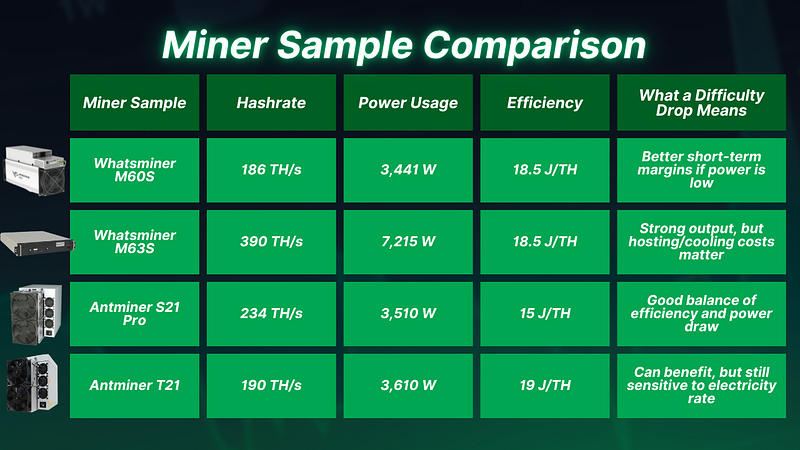
A difficulty drop can help these miners earn a slightly larger share of rewards in the short term. However, the real impact still depends on electricity cost, uptime, and cooling. Models like the Antminer S21 Pro may handle tighter market conditions better because of stronger efficiency, while higher-power hydro units need stable hosting conditions to keep margins healthy.
Compare ASIC miners here:
https://asicprofit.com/miners
Revenue Relief May Be Temporary
A difficulty drop can improve expected rewards, but miners should avoid treating it as a long-term guarantee. Hashrate can return quickly if conditions improve, and difficulty can rise again in the next adjustment cycle.
Bitcoin mining reports earlier showed hashrate holding near 978 EH/s, difficulty around 136.6 T, and miner revenue at $252 million before the later period of higher difficulty and lower revenue.
That shift shows how quickly mining conditions can change.
What Miners Should Do Now
Miners should use a possible difficulty drop as a chance to review their setup, not as a reason to stop calculating. Check your electricity cost, machine efficiency, uptime, cooling, and ROI timeline.
If your miner is barely profitable, lower difficulty may help for a short period. If your miner is already efficient and operating at a low power rate, it may improve margins more clearly.
Conclusion
A Bitcoin difficulty drop can be good news for miners, but it is not a full solution by itself. Profitability still depends on power cost, ASIC efficiency, uptime, cooling, and market conditions.
The smartest move is to recalculate before making decisions. Use AsicProfit to compare miners, estimate costs, and check whether your ASIC is still worth running.
Calculate your ROI now at https://asicprofit.com
#AsicProfit #BitcoinMining #ASICMining #Asicminer
Stay Connected
🎥 YouTube