
ASIC mining profitability can change quickly. A miner that looked profitable last week may produce lower returns today because of changes in Bitcoin price, network difficulty, electricity costs, or hardware efficiency. That is why miners need to look at current numbers instead of relying on old estimates.
Today, the biggest factors affecting ASIC mining profitability are electricity rates, mining difficulty, ASIC efficiency, uptime, and real-time ROI planning. Miners who understand these factors can make better decisions, protect profits, and avoid running machines at a loss.
At AsicProfit, miners can compare ASIC miners, estimate electricity costs, and calculate ROI using current profitability data.
Why ASIC Mining Profitability Changes Daily
Mining is not fixed income. It depends on several moving parts that can shift every day. Bitcoin price can rise or fall, network difficulty can increase, and electricity costs can change depending on location or hosting setup.
For miners, this means profitability should be checked regularly. A setup that works well at one electricity rate may become much less profitable at a higher rate.
The more accurate your numbers are, the easier it is to make smart mining decisions.
Factor #1: Electricity Cost Is Still the Biggest Expense
Electricity remains the largest ongoing cost in ASIC mining. Even if a miner has strong hash rate, high power costs can reduce or completely erase profits.
For a 5.5 kW ASIC miner, electricity costs can vary significantly depending on the power rate. At $0.06/kWh, the estimated monthly cost is around $238. If the rate increases to $0.08/kWh, the monthly cost rises to about $317. At $0.10/kWh, the same miner would cost roughly $396 per month to operate. This shows how even small electricity rate differences can have a major impact on mining profitability over time.
At $0.06/kWh, the miner costs around $238 per month to run. At $0.10/kWh, that cost rises to about $396 per month. That difference is nearly $1,900 per year for one miner.
This is why miners should always calculate power costs before buying hardware or scaling their setup.
Use the AsicProfit calculator to estimate electricity impact: https://asicprofit.com/calculator
Factor #2: Mining Difficulty Is Increasing Competition
Mining difficulty affects how hard it is to earn rewards. When more miners join the network, difficulty usually increases. This means each miner earns a smaller share unless they improve efficiency or increase hash power.
For Bitcoin miners, rising difficulty can make older ASIC machines less profitable over time.
External market data can be tracked through CoinMarketCap: https://coinmarketcap.com/currencies/bitcoin/
What Rising Difficulty Means
- Older miners may earn less
- ROI timelines may become longer
- Efficient miners gain an advantage
- Electricity cost becomes even more importan
Miners should check difficulty trends regularly and recalculate profitability when conditions change.
Factor #3: ASIC Efficiency Matters More Than Raw Hash Rate
Hash rate is important, but efficiency often decides whether a miner stays profitable. ASIC efficiency is usually measured in J/TH, or joules per terahash. Lower J/TH means the miner uses less electricity to produce hash power.
ASIC miners below 10 J/TH usually have the strongest profitability outlook because they deliver more output with less electricity. Mid-range miners between 15–25 J/TH can still perform well when electricity costs are low. Older miners above 30 J/TH may struggle unless power is extremely cheap.
Compare ASIC miner performance here: https://asicprofit.com/miners
Factor #4: Uptime and Cooling Affect Real Profit
A miner only earns when it is online and performing properly. Downtime, overheating, and poor ventilation can reduce actual earnings even if the miner looks profitable on paper.
Heat is especially important. When ASIC miners overheat, they may throttle performance, lower hash rate, or use power less efficiently.
To protect profitability, miners should:
- Keep airflow clean and stable
- Monitor miner temperatures
- Remove dust from fans and vents
- Check pool connections
- Track uptime regularly
Stable operation often matters just as much as miner specifications.
Factor #5: Coin Selection Can Change Short-Term Profitability
Bitcoin is the most popular ASIC mining option, but it is not always the only profitable coin. Depending on the miner model, some ASIC miners may earn better short-term returns from coins like Kaspa, Litecoin, or Dogecoin.
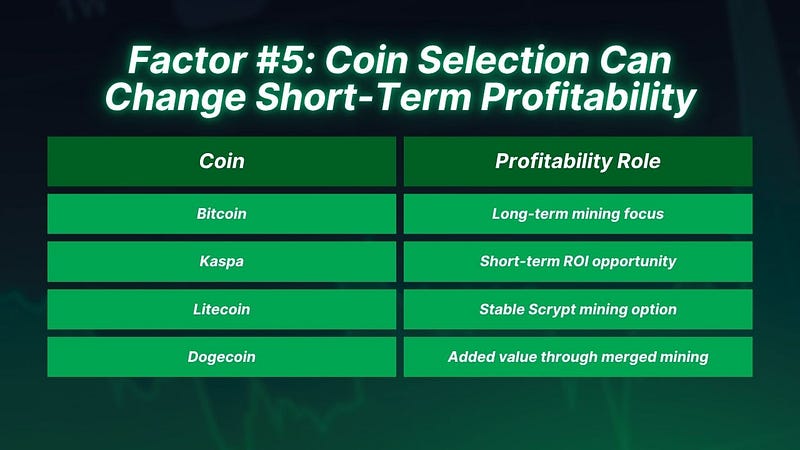
For miners with flexible hardware, comparing coins can help improve returns. However, coin switching should always be based on current profitability data, not hype.
Check coin profitability here: https://asicprofit.com/coins
Factor #6: ROI Planning Helps Avoid Bad Decisions
Many miners focus on daily profit, but ROI is the bigger picture. ROI shows how long it may take to recover the cost of a miner.
A miner earning daily profit may still be a poor investment if the payback period is too long.
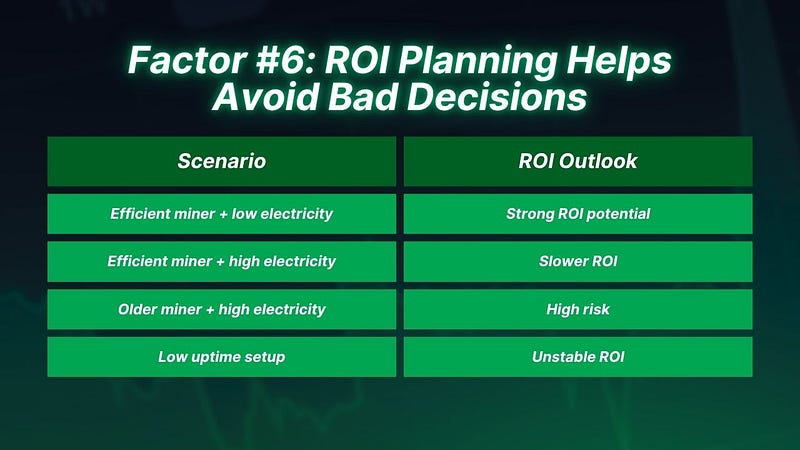
Before buying a miner or changing your setup, calculate expected revenue, electricity cost, and payback time.
Calculate your ROI now: https://asicprofit.com/calculator
What Miners Should Check Today
Before the day ends, miners should review the most important profitability numbers:
- Current Bitcoin price
- Network difficulty
- Electricity rate
- Miner efficiency
- Actual hash rate
- Uptime and temperature
- ROI timeline
These simple checks can help miners avoid preventable losses and make better decisions.
Conclusion
ASIC mining profitability today depends on more than just running a powerful machine. Electricity costs, mining difficulty, ASIC efficiency, uptime, cooling, coin selection, and ROI planning all affect real profit.
The miners who perform best are usually the ones who understand their numbers and adjust quickly when conditions change.
Before buying new hardware, switching coins, or scaling your mining setup, use AsicProfit to compare miners, calculate electricity costs, and estimate ROI.
Calculate your ROI now at https://asicprofit.com
#AsicProfit #BitcoinMining #ASICMining #Asicminer
Stay Connected
🎥 YouTube