AsicProfit: Should You Upgrade Your ASIC or Keep Mining?
Should you upgrade your ASIC or keep mining? Learn how to compare efficiency, electricity cost, and ROI using AsicProfit before making a decision.

Every serious miner eventually faces the same question:
Should I upgrade my ASIC — or keep mining with what I already have?
The answer isn’t emotional. It’s mathematical.
At AsicProfit, upgrade decisions are evaluated using efficiency, electricity cost, and break-even timelines — not hype or hardware marketing.
Let’s break this down properly.
Miners typically consider upgrading because:
But upgrading doesn’t automatically mean better ROI.
Sometimes the smartest move is to keep mining.
Most miners compare:
But the correct comparison is:
Net Profit = Revenue − Electricity Cost
And more importantly:
Profit per TH/s
Higher hashrate alone doesn’t justify replacement if ROI resets.
👉 Compare live miner profitability here:
https://www.asicprofit.com/miners
You are fully in profit phase.
But now you must recover:
$6,000 ÷ $24 ≈ 250 days
You’ve reset your ROI clock.
The real question becomes:
Is the additional $9/day worth 250 days of new capital exposure?
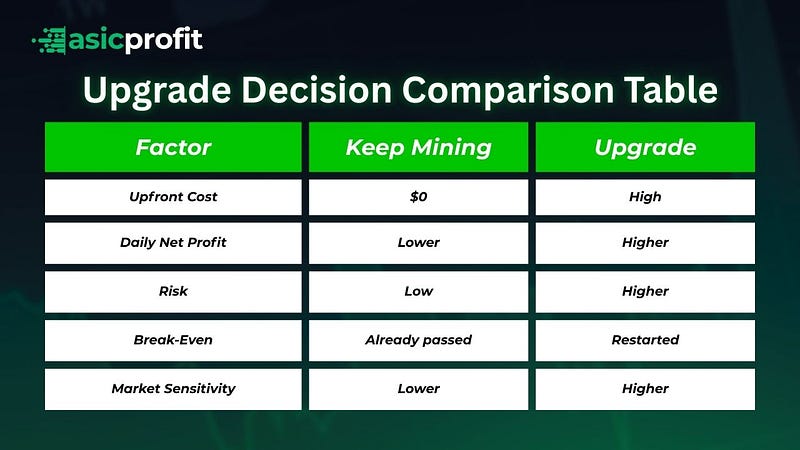
If your current unit is still profitable, upgrading increases risk.
Older miners struggle when electricity rises.
Test both units at your real kWh rate:
👉 Model electricity impact here:
https://www.asicprofit.com/calculators
If your existing miner becomes unprofitable at current power cost, upgrading may make sense.
If it still produces positive net profit, replacing it may reduce capital efficiency.
Upgrading during:
Strategic miners often upgrade when:
Timing affects ROI as much as hardware choice.
A practical rule many miners use:
Upgrade only if:
If the efficiency gain is small, the capital reset may not justify it.
Upgrading includes:
Keeping a stable, already-paid-off miner often produces consistent cash flow.
Upgrade if:
Keep mining if:
Capital preservation is a strategy too.
Instead of guessing, AsicProfit lets you:
This removes emotion from the decision.
👉 Start comparing before upgrading:
https://www.asicprofit.com/
Upgrading your ASIC is not always the smartest move.
Sometimes the most profitable miner is the one you already own.
The right decision depends on:
Use data — not excitement — to decide.
🎥 YouTube