
Mining profits can change quickly. A miner that looked profitable last week may deliver weaker returns this week because of Bitcoin price movement, network difficulty, electricity costs, or hardware performance. For ASIC miners, protecting profits is not only about earning more. It is also about reducing avoidable losses.
This week, the most important profit protection strategies are simple but powerful: control electricity costs, monitor efficiency, review ROI regularly, and use real-time profitability data before making decisions.
At AsicProfit, miners can compare ASIC miners, estimate power costs, and calculate ROI so they can make smarter weekly decisions.
Why Profit Protection Matters in ASIC Mining
ASIC mining is a business of margins. Revenue matters, but net profit matters more. Many miners focus only on daily earnings without checking how much electricity, downtime, heat, and difficulty changes are reducing their actual returns.
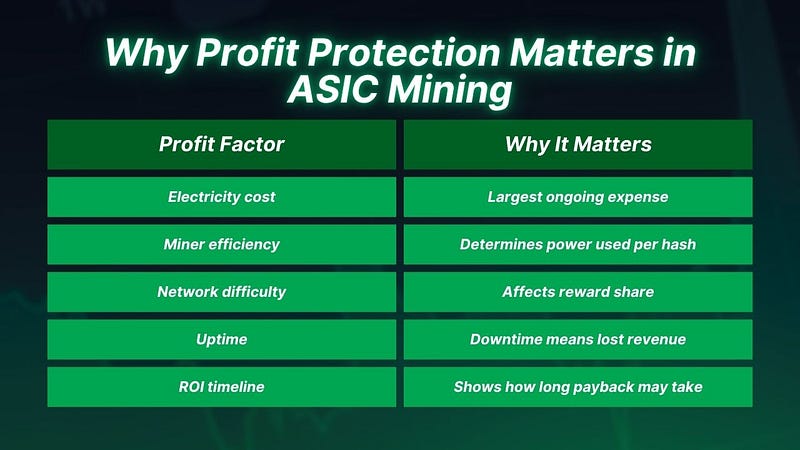
A miner can appear profitable on paper but become much less attractive after operating costs are included.
Protecting mining profits starts with knowing these numbers clearly.
Strategy #1: Track Electricity Costs Every Week
Electricity is usually the biggest cost in ASIC mining. Even a small increase in power rate can reduce profitability over time.
For example, a 5.5 kW ASIC miner running 24/7 uses about 132 kWh per day. The monthly cost changes quickly depending on the electricity rate.
At $0.06/kWh, the miner costs around $238 per month to operate. At $0.10/kWh, that rises to about $396 per month. That difference is nearly $1,900 per year per miner.
This is why miners should calculate electricity impact before buying hardware, switching locations, or scaling operations.
Use the AsicProfit calculator to estimate your power cost and ROI: https://asicprofit.com/calculator
Strategy #2: Focus on ASIC Efficiency, Not Just Hash Rate
Hash rate is important, but it does not tell the full story. A miner with a high hash rate can still be less profitable if it uses too much electricity.
Efficiency is usually measured in J/TH, or joules per terahash. The lower the number, the more efficient the miner.
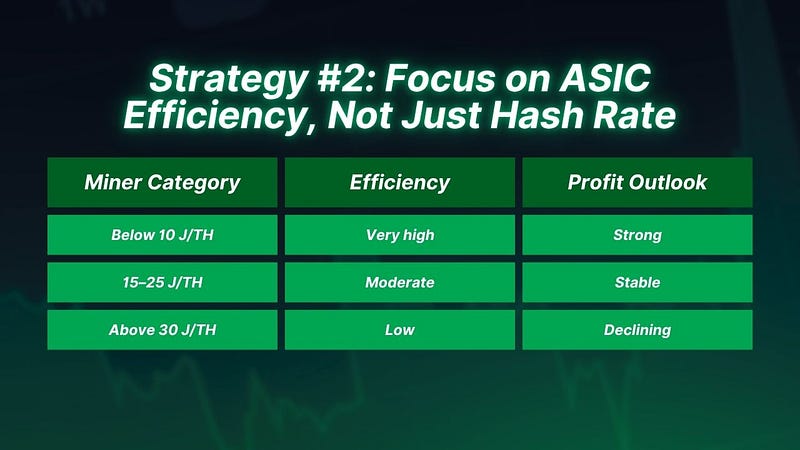
Miners below 10 J/TH usually have a stronger advantage because they produce more hash power with less energy. Mid-range miners can still work well if electricity is affordable. Older miners above 30 J/TH may struggle unless power costs are very low.
Compare ASIC miner efficiency here: https://asicprofit.com/miners
Strategy #3: Monitor Mining Difficulty and Market Conditions
Bitcoin mining difficulty changes regularly. When difficulty rises, miners earn less reward for the same amount of hash power. If Bitcoin price does not rise enough to offset the difficulty increase, profit margins can shrink.
This is why miners should not rely on old profitability numbers.
External market data can be tracked through sources like CoinMarketCap: https://coinmarketcap.com/currencies/bitcoin/
What to Watch Weekly
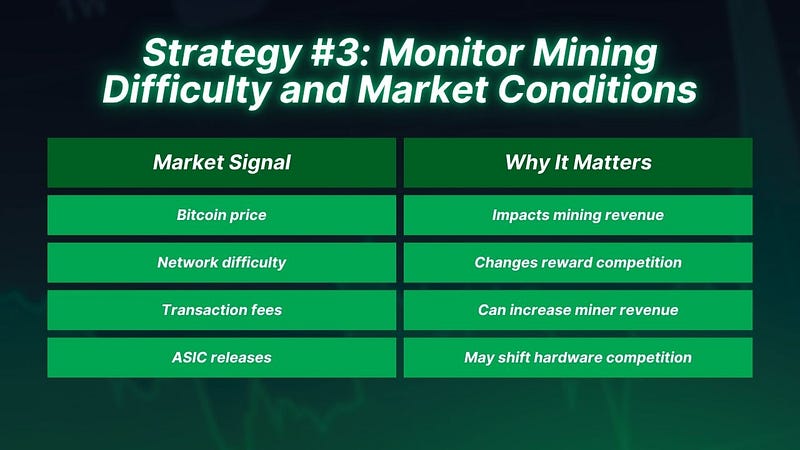
Weekly monitoring helps miners react faster instead of waiting until profits drop.
Strategy #4: Reduce Downtime and Heat Losses
Downtime is one of the easiest ways to lose mining income. If a miner is offline, it is not earning. If it overheats, it may throttle performance and reduce hash rate.
Heat can also increase hardware stress and shorten equipment lifespan.
To protect profits, miners should:
- Keep airflow clean and consistent
- Remove dust from fans and vents
- Monitor miner temperatures
- Use stable internet and power connections
- Check pool performance regularly
A miner running consistently at stable temperatures is usually more profitable than one that frequently drops performance.
Strategy #5: Recalculate ROI Before Making Changes
Many miners make decisions based on excitement instead of numbers. Buying a new miner, switching coins, or moving to hosting should always start with ROI planning.
ROI tells you how long it may take to recover your investment.
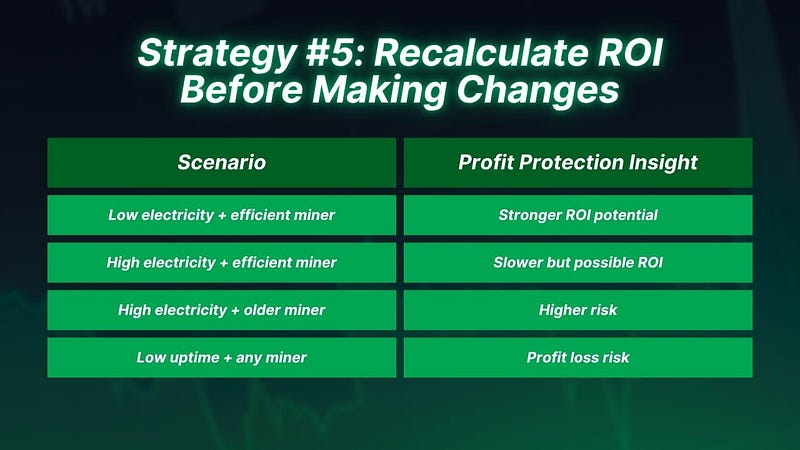
Before making a purchase or changing strategy, miners should compare expected daily profit, monthly cost, and payback time.
Calculate your ROI now: https://asicprofit.com/calculator
Strategy #6: Compare Coins, Not Just Machines
Bitcoin remains the most popular mining option, but it is not always the only profitable choice. Depending on your ASIC miner, coins like Kaspa, Litecoin, and Dogecoin may offer competitive returns.
For some miners, switching to a more profitable coin can improve short-term earnings. Bitcoin remains the main choice for long-term mining because of its market strength and stability. Kaspa is worth watching for miners looking for stronger short-term ROI opportunities, while Litecoin continues to offer a stable option for Scrypt mining. Dogecoin can also add extra value through merged mining, especially for miners already using compatible hardware.
Use AsicProfit to compare coin profitability before switching: https://asicprofit.com/coins
Weekly Profit Protection Checklist
Before the week ends, miners should review these items:
- Check current electricity cost
- Compare actual hash rate vs expected hash rate
- Review miner temperature and uptime
- Recalculate ROI using current data
- Compare coin profitability
- Watch Bitcoin price and difficulty changes
- Decide whether to optimize, hold, or upgrade
This simple weekly habit can help miners avoid preventable losses.
Conclusions
Protecting mining profits is about discipline. The miners who do well over time are not always the ones with the most expensive machines. They are often the ones who understand their numbers, control costs, and adjust quickly when market conditions change.
This week, electricity cost, ASIC efficiency, uptime, and ROI planning remain the most important areas to watch.
Before making your next mining decision, use AsicProfit to compare miners, calculate costs, and estimate your ROI.
Calculate your ROI now at https://asicprofit.com
#AsicProfit #BitcoinMining #ASICMining #Asicminer
Stay Connected
🎥 YouTube