AsicProfit: What Is Mining Difficulty and How Does It Work?
Learn what mining difficulty is and how it affects crypto mining profitability. Discover how ASICProfit helps miners calculate ROI and analyze mining performance.

If you’ve ever looked at a mining dashboard or profitability calculator, you’ve probably seen the term mining difficulty.
But what does it actually mean?
Mining difficulty is one of the most important variables in crypto mining. It determines how hard it is for miners to find new blocks and earn rewards. At AsicProfit, difficulty is a key factor used to calculate real mining profitability and realistic ROI projections.
Understanding mining difficulty helps miners make smarter hardware and investment decisions.
Mining difficulty is a measurement of how hard it is to solve the cryptographic puzzle required to validate a block on a blockchain network.
The purpose of difficulty is simple:
To keep block production consistent.
For example:
If miners add more computing power to the network, blocks would normally be found faster. Difficulty increases automatically to maintain the target block time.
Without difficulty adjustments, block times would become unpredictable.
Difficulty ensures:
In simple terms, it prevents the network from producing blocks too quickly when more miners join.
Different blockchains adjust difficulty at different intervals.
Example (Bitcoin):
If blocks were mined faster than expected during that period, difficulty increases.
If blocks were mined slower, difficulty decreases.
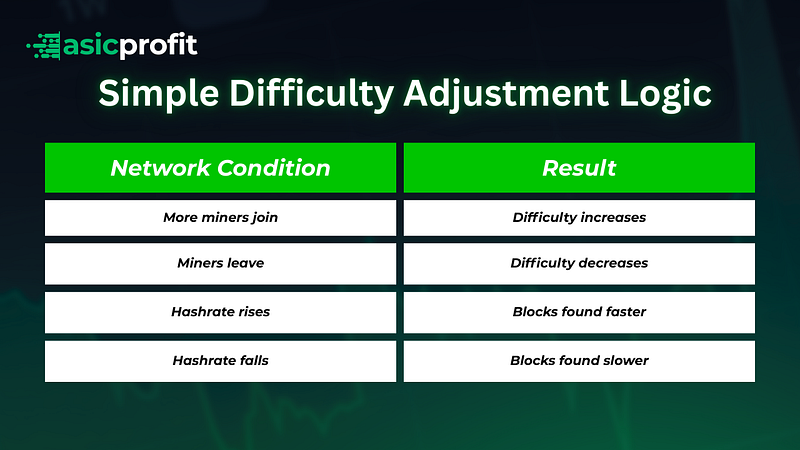
Difficulty acts as the network’s automatic balancing system.
Many miners confuse these two concepts.
Hashrate is the total computing power miners contribute to the network.
Difficulty adjusts to match the total hashrate so blocks continue to appear at the expected rate.
Relationship:
More Hashrate → Higher Difficulty
Less Hashrate → Lower Difficulty
This relationship directly affects mining profitability.
When difficulty increases:
When difficulty decreases:
Even if the coin price stays the same, rising difficulty can reduce mining income.
Assume a miner earns:
If network difficulty increases 20%, revenue may fall approximately:
$25 × 0.80 = $20/day
Nothing changed about your hardware.
The network simply became more competitive.
Most major mining networks see long-term difficulty growth because:
This is why efficiency and electricity cost matter so much for long-term profitability.
Difficulty growth is one of the biggest risks when calculating mining ROI.
If difficulty increases faster than expected:
That’s why profitability modeling should always account for difficulty changes.
Instead of guessing, miners can use ASICProfit tools to model profitability under current network conditions.
With ASICProfit you can:
👉 Compare miners here:
https://www.asicprofit.com/miners
👉 Test mining profitability:
https://www.asicprofit.com/calculators
This allows miners to understand how difficulty affects real-world profitability.
Mining profitability depends on both:
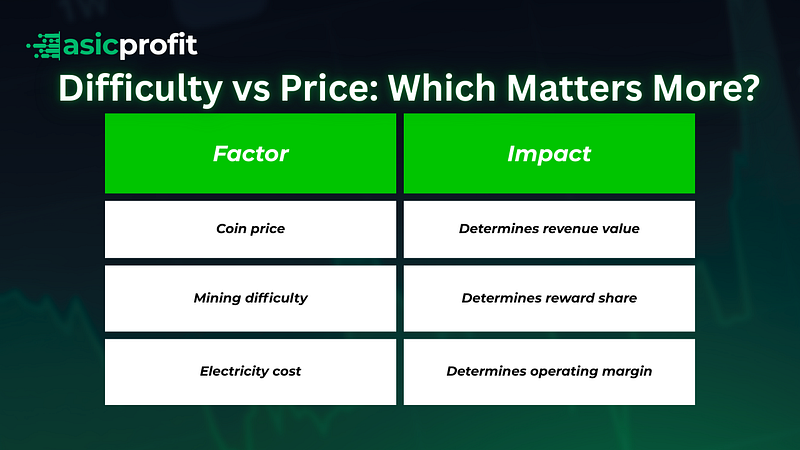
Sometimes coin prices rise faster than difficulty, increasing profits.
Other times difficulty rises faster than price, reducing profits.
Mining is always a balance between these variables.
Mining difficulty is the network’s way of maintaining stability and fairness.
As more miners join a network, difficulty increases to keep block production consistent. This means profitability constantly evolves.
Successful miners understand that profitability isn’t static. It depends on:
Using data-driven tools like ASICProfit helps miners analyze these factors and make smarter decisions before investing in hardware.
🎥 YouTube