
Bitcoin Mining Today: Why Efficient ASICs Are Winning
Bitcoin mining is entering a market where raw power is no longer enough.
A miner can produce an impressive hashrate and still deliver disappointing returns when electricity consumption, cooling requirements, downtime, and infrastructure costs are included. As competition becomes stronger, miners are paying more attention to how efficiently each machine converts electricity into computing power.
This shift is changing the way ASIC hardware is evaluated. Instead of asking only, “How many terahashes does it produce?” miners are increasingly asking, “How much does each terahash cost to generate?”
That question is becoming central to long-term profitability.
With AsicProfit, miners can compare hardware, adjust electricity rates, estimate operating costs, and calculate potential ROI before committing to a machine.
Hashrate Alone Does Not Show Real Profitability
Hashrate measures how much computational work an ASIC miner can perform. Higher hashrate generally means a greater contribution to a mining pool and a larger potential share of rewards.
However, hashrate does not show the full operating picture.
Two miners can produce strong output while delivering very different financial results. One may use less electricity, require simpler cooling, and remain stable for longer periods. The other may consume much more power and require expensive infrastructure.
A useful miner comparison should consider:
- Hashrate
- Power consumption
- Efficiency
- Electricity rate
- Cooling requirements
- Expected uptime
- Hardware price
- Payback period
A high-hashrate miner is only valuable when the revenue it generates remains comfortably above its total operating cost.
Why J/TH Is Becoming the Number to Watch
ASIC efficiency is commonly measured in joules per terahash, or J/TH. This number shows how much energy the machine needs to produce one terahash of computing power.
A lower J/TH rating means better efficiency.
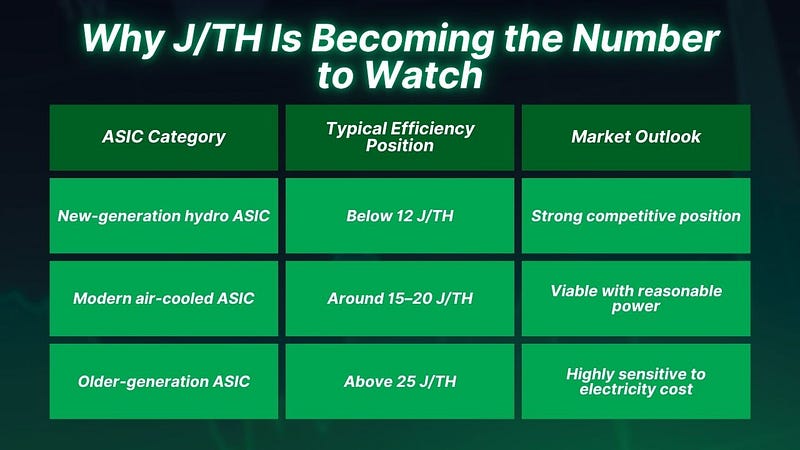
The importance of J/TH becomes clearer when mining revenue falls. An inefficient machine may lose most of its margin because it must keep paying for the same electricity even when expected revenue declines.
An efficient machine has more room to absorb difficult conditions.
This does not guarantee profit, but it creates a stronger operating position.
Compare ASIC hardware using AsicProfit:
Electricity Prices Widen the Efficiency Gap
Electricity is usually the largest recurring mining expense. When two operators use the same miner but pay different power rates, their profitability can look completely different.
Consider a sample 3.6 kW ASIC miner running continuously:
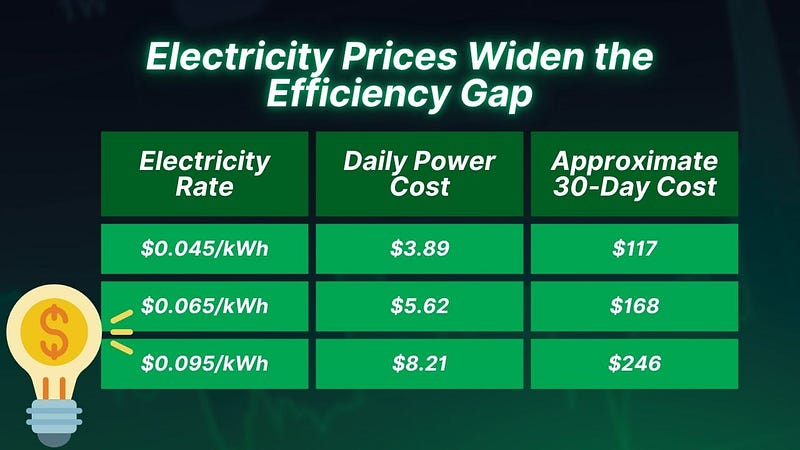
The miner produces the same hashrate in every example, but the operation paying $0.095/kWh spends approximately $129 more each month than the operation paying $0.045/kWh.
Across ten machines, that difference becomes approximately $1,290 per month before pool fees, repairs, or cooling costs are considered.
This is why an efficient ASIC paired with affordable electricity can outperform a more powerful machine running under an expensive energy contract.
Calculate power costs and potential ROI here:
https://asicprofit.com/calculator
Efficient ASICs Offer More Flexibility
Better efficiency gives miners more options when market conditions change.
An efficient machine may allow an operator to:
- Continue running during lower-revenue periods
- Use underclocking to reduce energy consumption further
- Maintain stronger margins after difficulty increases
- Recover hardware costs more predictably
- Operate profitably across a wider range of electricity rates
Older machines usually have a narrower operating window. Once revenue declines or electricity becomes more expensive, they can quickly approach breakeven.
This is one reason professional mining farms often replace inefficient units instead of adding more older hardware. Ten outdated miners may produce substantial hashrate, but a smaller group of efficient machines can sometimes deliver better net results with less electrical and cooling demand.
Cooling Efficiency Also Matters
Hardware efficiency is only one part of the operation.
ASIC miners produce continuous heat, and that heat must be removed. Poor ventilation can cause thermal throttling, fan stress, unstable performance, and additional downtime.
Cooling methods also have different operating requirements:
Air Cooling
Air-cooled machines are generally easier to deploy, but they require strong airflow, clean intake air, heat separation, and regular dust management.
Hydro Cooling
Hydro-cooled ASICs can maintain stable temperatures and support high-density deployments, but they require pumps, plumbing, heat exchangers, water-quality management, and compatible infrastructure.
Immersion Cooling
Immersion cooling can reduce noise and support stable thermal performance, but the tanks, fluid, pumps, and maintenance procedures add capital and operational costs.
The most efficient ASIC on paper can still produce weak results if the surrounding infrastructure is poorly designed.
Uptime Converts Efficiency Into Revenue
A miner cannot earn while it is offline.
For that reason, uptime should be evaluated alongside J/TH. A highly efficient miner that frequently disconnects, overheats, or waits days for maintenance may generate less revenue than expected.
Miners should monitor:
- Actual pool hashrate
- Rejected-share rate
- Machine temperature
- Network stability
- Power interruptions
- Repair response time
- Historical uptime
Efficiency describes what the miner can achieve. Uptime determines how often it achieves it.
Who Benefits Most From Efficient ASIC Hardware?
Efficient miners are especially valuable for operators who face tighter energy limits or plan to mine over a longer time horizon.
They may be suitable for:
- Professional hosting customers
- Mining farms with limited available power
- Operators replacing older fleets
- Miners planning multi-year strategies
- Businesses focused on predictable ROI
- Facilities seeking higher hashrate density
For a beginner, the cheapest machine may look attractive. However, a lower purchase price can be misleading when the machine consumes more electricity every day.
The correct comparison is not simply purchase price versus hashrate. It is total acquisition and operating cost versus expected lifetime revenue.
How AsicProfit Helps With Miner Selection
No ASIC miner is automatically the best choice for every operator.
Profitability depends on local electricity rates, hardware pricing, network conditions, pool fees, and expected uptime. A machine that works well at $0.05/kWh may be difficult to justify at $0.12/kWh.
With AsicProfit, miners can review hardware options and test different operating scenarios before purchasing.
A useful comparison should answer three questions:
- How much revenue could the machine generate?
- How much will electricity cost?
- How long could it take to recover the investment?
These calculations help turn hardware specifications into practical business decisions.
Conclusion
Efficient ASICs are winning because modern Bitcoin mining rewards operations that produce more computing power from every unit of electricity.
Hashrate still matters, but it cannot be separated from power consumption, cooling, uptime, and ROI. As competition continues, machines with lower J/TH ratings generally have a better chance of remaining viable across changing market conditions.
Before buying or upgrading an ASIC miner, compare the complete operating picture rather than choosing the machine with the largest hashrate.
Use AsicProfit to compare miners, estimate electricity costs, and calculate your potential returns.
Calculate your ROI now: https://asicprofit.com
#AsicProfit #BitcoinMining #ASICMining #Asicminer
Stay Connected
🎥 YouTube