
🏁 Introduction: Why ROI Still Rules in 2025
When I first started mining crypto back in the early days of 2018, the buzzword was always ROI. Everyone wanted to know how fast their investment in a machine would pay off. Fast-forward to 2025, and the question hasn’t changed — just the hardware, prices, and electricity rates have.
But here’s the kicker: today’s ASIC miners are more efficient than ever, but margins are tighter, and electricity costs vary wildly depending on where you’re plugged in. Whether you’re just entering the mining game or scaling your farm, understanding your Return on Investment (ROI) is no longer optional — it’s essential to surviving this evolving game.
Let me break it down for you in the most practical, human way possible.
💻 What Is Crypto Mining Hardware?
Crypto mining hardware, also known as ASIC (Application-Specific Integrated Circuit) miners, are purpose-built machines designed to perform one job: validate blockchain transactions and mine coins like Bitcoin, Kaspa, Dogecoin, Aleo, and others.
They’re not your average PC. These machines are engineered with one goal in mind: hash as fast and efficiently as possible. Think of them as the turbocharged engines of crypto.
They’re powerful, loud, and energy-hungry — but when managed correctly, they can be incredibly profitable. And unlike GPUs or CPUs, ASICs are laser-focused on a single algorithm (e.g., SHA-256 for Bitcoin or kHeavyHash for Kaspa).
📊 How ROI Works for ASIC Miners
🔍 Formula for ROI:
ROI (%) = (Net Profit / Total Investment) × 100
Where:
- Net Profit = Total Earnings — Operating Costs (Electricity, Hosting, Maintenance)
- Total Investment = ASIC Hardware + Setup + Hosting Deposit (if any)
🧠 Example Scenario:
Let’s say you purchase a Bitmain Antminer S21 (200 TH/s) for $5,000 in 2025. You’re hosting it at a site that charges $0.0525 per kWh (like Oneminers’ Nigeria location). Here’s what it might look like:
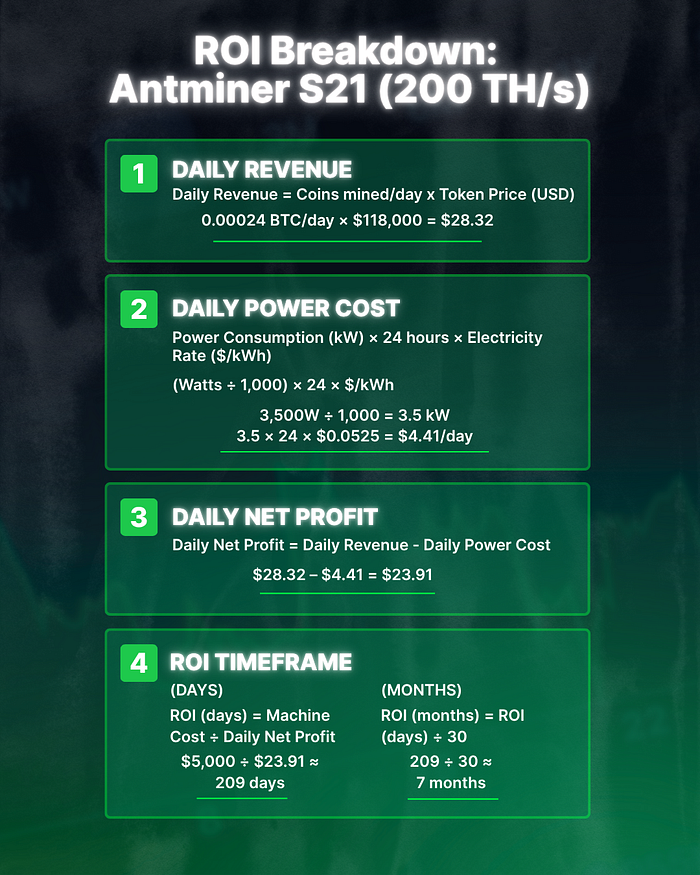
✅ That’s under 7 months for full ROI — assuming stable BTC prices and network difficulty.
📉 Factors That Affect ROI in 2025
Let’s keep it real — crypto mining isn’t plug-and-play. There are multiple moving pieces. These variables seriously impact your ROI:
1. ⚡ Electricity Cost
Still the biggest operational expense. Look for hosting services with $0.04–$0.07/kWh rates. Anything higher eats away your margins.
2. 🧱 Network Difficulty
The more miners there are, the harder it gets to earn coins. Always monitor difficulty levels and block rewards.
3. 🛠️ Hardware Lifespan
Most ASICs run profitably for 2–4 years if well maintained. Refurbished models (like the IceRiver AE1 Lite) can offer solid ROI if the upfront cost is low.
4. 🌍 Hosting Location
Cooler climates = less heat stress on machines. Cheap power + stable infrastructure = better uptime and lower maintenance.
5. 🧮 Pool Fees & Downtime
Mining pools charge fees (1–2%). Also factor in occasional downtime for firmware updates or power cuts. It adds up over time.
📐 Easy ROI Calculator Flow
Here’s a visual breakdown of how to calculate ROI for any crypto mining hardware:
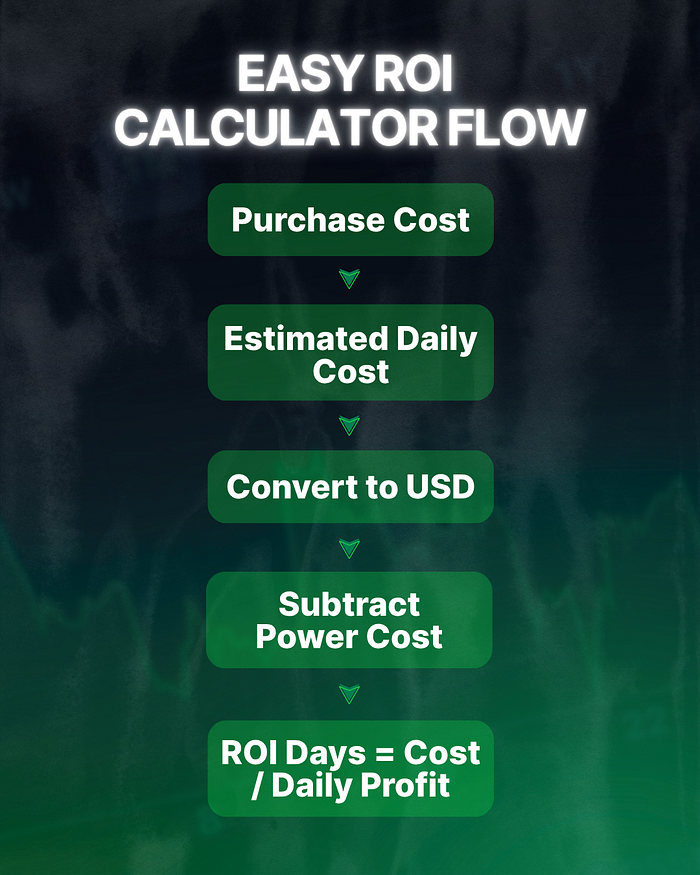
📍 Pro Tip: Use tools like ASICProfit.com to calculate ROI instantly using real-time miner specs, power costs, and coin prices.
🧪 Real-Life Example: Kaspa Miner (IceRiver KS3M)
Let’s run another real-life example, this time for Kaspa:
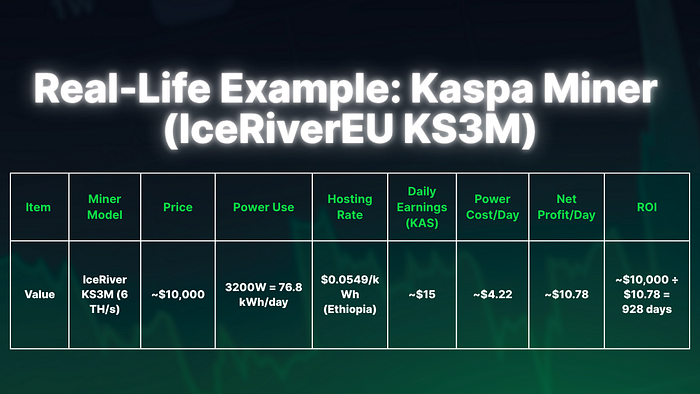
🔁 ROI is longer here, but if Kaspa price pumps again (like in early 2024), your earnings could double overnight. Risk and reward go hand in hand.
Should You Buy or Host?
Here’s a quick comparison to help you decide:
🏠 Home Mining:
- ❌ Noisy
- ❌ Higher local electricity cost
- ✅ Full control of your machine
🌐 Hosting:
- ✅ Cheaper electricity
- ✅ Better uptime
- ✅ Passive setup
- ❌ Depends on the hosting provider
Verdict? For most people in 2025, hosting wins — especially in locations like Ethiopia, Nigeria, or UAE with sub-$0.06/kWh rates.
📌 Final Tips Before You Buy Crypto Mining Hardware
- Don’t just chase hashrate. Efficiency (J/TH) matters more than raw power.
- Use ASIC profitability calculators daily. The market is volatile. Stay updated.
- Buy from trusted sellers. Look for warranties, real reviews, and support.
- Plan for downtime. Firmware updates, repairs — they’re part of the game.
- Reinvest your profits. This is how pro miners scale. Compound that ROI.
🎯 Conclusion: ROI is a Strategy, Not a Guess
In 2025, mining is still one of the most profitable ways to earn crypto — but only if you approach it with clarity. ROI isn’t just a number — it’s a plan.
Know your costs. Track your earnings. Adapt quickly.
And if you want to make smarter decisions, I highly recommend checking out ASICProfit it’s the go-to tool I use to compare miners, power costs, and daily earnings.
💬 Got questions or want to share your own ROI story?
Drop a comment below — I’d love to hear what you’re mining and how it’s going!
🔗 Stay Connected
🎥 YouTube