
Latest ASIC Mining Update: Hashprice Improves as Competition Returns
ASIC mining conditions are showing signs of improvement, but the market is not suddenly easy again.
During the week ending July 20, 2026, Bitcoin’s price, network hashrate, transaction fees, and hashprice all moved higher. Mining difficulty remained unchanged, creating a slightly healthier revenue environment for active miners without immediately increasing the amount of work required to compete for blocks.
That is positive news after several months of pressure. However, the latest numbers also show why miners still need to stay disciplined. A modest recovery in mining revenue can disappear quickly when electricity costs, inefficient hardware, cooling expenses, or downtime are ignored.
For miners reviewing new equipment or deciding whether to keep older machines online, the latest update reinforces one basic rule: profitability depends on the complete operating setup, not just Bitcoin’s price.
With AsicProfit, miners can compare ASIC hardware, estimate electricity expenses, and test different ROI scenarios using their own power rate.
Bitcoin Mining Conditions Improved This Week
The latest weekly mining report described the market as broadly positive. Bitcoin increased by approximately 4.1% over the week, while network hashrate and hashprice also recovered. Miners collected around 3,208 BTC in block rewards, worth approximately $204 million at the time of the report. Transaction fees contributed another 21 BTC, or roughly $1.33 million.
These changes matter because miner revenue is influenced by several moving parts:
- Bitcoin’s market price
- Network difficulty
- Total network hashrate
- Transaction fees
- Pool performance
- ASIC efficiency
When Bitcoin rises while difficulty stays flat, revenue per unit of hashrate can improve. That does not mean every miner becomes profitable, but efficient operations receive some breathing room.
Hashrate Is Recovering
Network hashrate rose during the latest reporting week, suggesting that computing power is returning to the Bitcoin network.
A recovering hashrate can have two meanings for ASIC operators.
First, it may indicate that better mining economics are encouraging machines to come back online. Some operators temporarily shut down hardware when revenue falls below electricity and operating costs. When hashprice improves, those machines may become viable again.
Second, rising hashrate means competition is also returning. If the recovery continues, Bitcoin’s next difficulty adjustment could eventually move upward, reducing some of the short-term benefit miners are currently seeing.
This is why miners should avoid making hardware decisions from a single good week. A stronger approach is to test whether a machine remains viable under several different market conditions.
Hashprice Is Moving Higher
Hashprice estimates the expected daily revenue produced by a unit of Bitcoin mining hashrate. It is one of the most useful indicators for understanding whether mining conditions are improving or weakening.
The latest report showed hashprice increasing alongside Bitcoin’s price and network activity.
For miners, higher hashprice generally means more gross revenue per petahash. However, gross revenue is not the same as net profit.
A machine can still lose money when:
- Its power efficiency is poor
- Electricity is expensive
- Pool fees are high
- Cooling consumes additional energy
- The machine experiences frequent downtime
- Repair costs are ignored
Hashprice tells miners what their computing power may earn. Electricity cost determines how much of that revenue they can keep.
Efficient ASICs Still Have the Advantage
The current market continues to favor modern ASIC miners with lower joules-per-terahash ratings.
An ASIC rated at 12 J/TH uses less energy to produce the same amount of hashrate than a machine operating at 25 or 30 J/TH. That difference becomes especially important during low-hashprice periods.
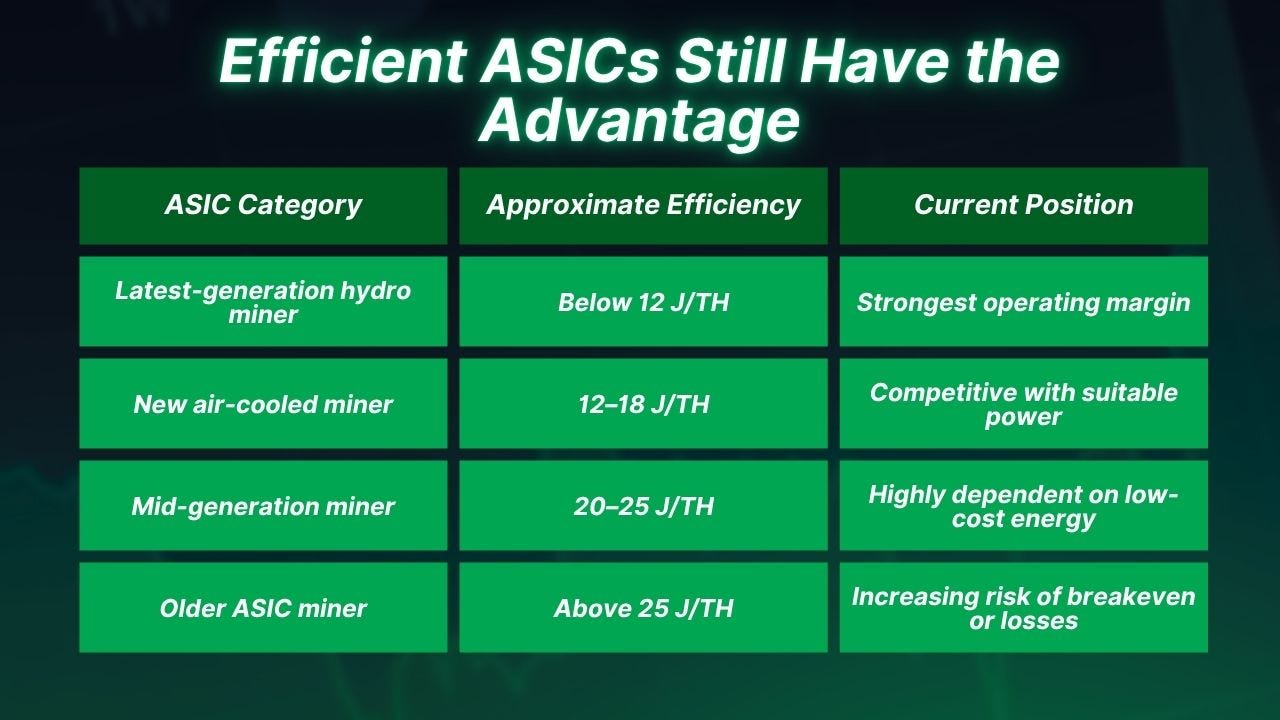
Newer hardware does not automatically guarantee a fast ROI because purchase prices may be high. Still, efficient machines generally have a wider operating window and can survive weaker mining conditions longer.
Canaan, for example, reported maintaining a fleet efficiency of 17.9 J/TH across its North American non-joint-venture operations while emphasizing cost control during difficult market conditions.
Compare current ASIC models here:
Electricity Cost Remains the Deciding Factor
Consider a 3.5 kW ASIC miner running continuously.
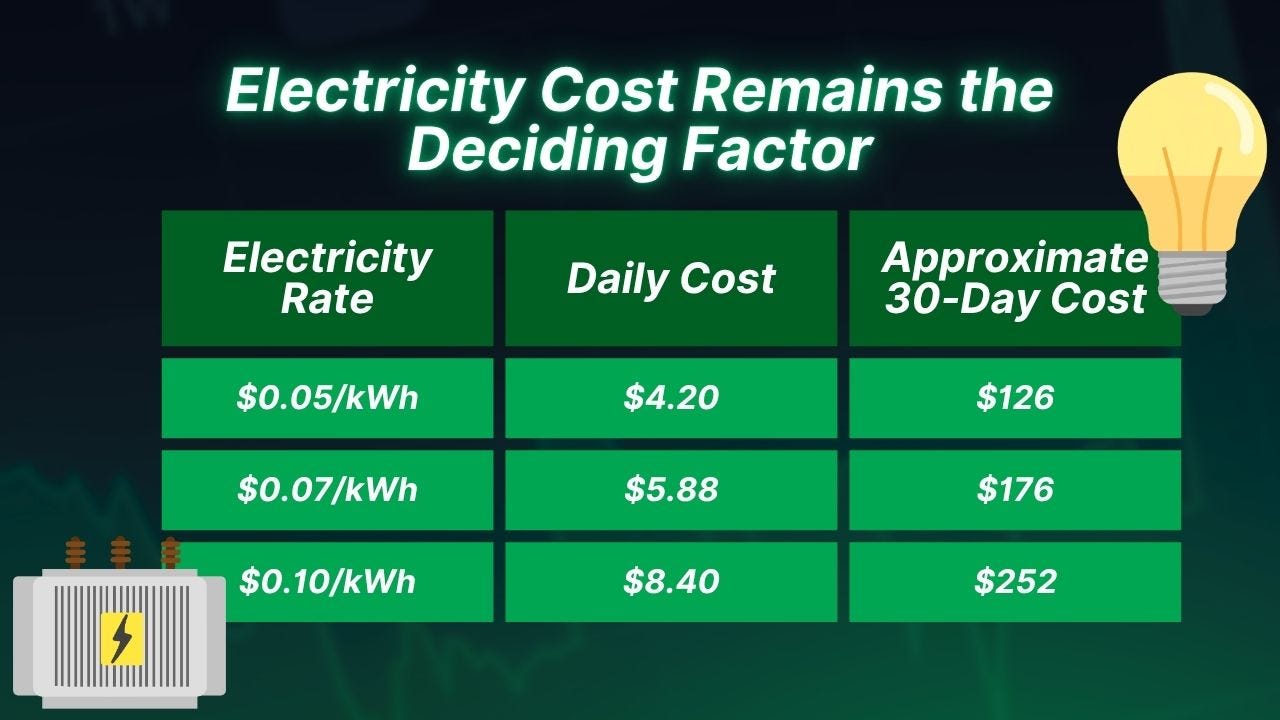
The machine produces the same hashrate at every rate, but the operator paying $0.10/kWh spends approximately $126 more each month than the operator paying $0.05/kWh.
Across ten miners, that gap reaches roughly $1,260 per month. Over one year, it becomes more than $15,000 before cooling, repairs, pool fees, and facility charges are included.
Research published in 2026 also found that Bitcoin mining facilities reduce power consumption when electricity-sector costs become too high relative to hashprice. In other words, miners increasingly adjust or curtail operations around their real breakeven point rather than keeping every machine online at all times.
Calculate your electricity cost and projected ROI:
https://asicprofit.com/calculator
Firmware and Security Are Becoming Bigger Issues
Profitability is not the only development ASIC operators should watch.
A recent security study analyzed 134 firmware images from major mining manufacturers, including Bitmain, MicroBT, Canaan, and IceRiver. Researchers found that firmware distribution systems can expose weaknesses that may support phishing, unauthorized access, or attacks against machines still using older mining protocols.
For operators, this means firmware should not be treated as a minor technical detail.
Miners should:
- Download firmware only from trusted manufacturer sources
- Verify model compatibility before installing updates
- Change default passwords
- Separate mining devices from sensitive business networks
- Monitor unexpected pool or wallet changes
- Avoid unverified firmware promising unrealistic hashrate gains
Third-party firmware can improve tuning and efficiency, but it should be evaluated carefully. A small performance increase is not worth risking an entire fleet.
New Hardware Is Focused on Efficiency and Density
ASIC manufacturers continue to push higher hashrate and lower energy use per terahash.
Canaan’s Avalon A16XP, for example, is listed at approximately 300 TH/s, 3,850 W, and 12.8 J/TH. This reflects the broader hardware trend toward producing more hashrate from each available megawatt.
Bitmain has also continued expanding its 2026 product lineup, including new SHA-256 and alternative-algorithm machines scheduled for shipment during the year.
For larger farms, hashrate density matters because facilities often have fixed limits for:
- Electrical capacity
- Transformer capacity
- Cooling
- Rack space
- Water flow for hydro systems
Replacing older machines with efficient models can increase total hashrate without increasing facility power demand by the same proportion.
What ASIC Miners Should Do Now
The latest recovery creates an opportunity to review operations, but it is not a reason to rush into hardware purchases.
Miners should use the current improvement to:
Recalculate Existing Machines
Update revenue assumptions using current hashprice, difficulty, and electricity rates. Older profitability estimates may no longer reflect today’s market.
Compare Efficiency, Not Just Hashrate
A high-hashrate machine with excessive power consumption can produce weaker net returns than a smaller but more efficient miner.
Stress-Test ROI
Calculate results at multiple Bitcoin prices and electricity rates. A good purchase should not depend entirely on the most optimistic scenario.
Review Uptime
Compare dashboard data with pool-side hashrate. A machine advertised at 300 TH/s is not delivering full value if repeated downtime reduces its average output.
Secure Firmware and Network Access
Review firmware sources, passwords, pool settings, and remote-access permissions before adding new equipment to an existing fleet.
Conlusion
The latest ASIC mining update is encouraging. Bitcoin, hashrate, fees, and hashprice all moved higher during the most recent week, while difficulty remained stable. That combination has improved short-term conditions for many operators.
Still, this is not a return to effortless mining profits.
The machines currently in the strongest position are those supported by efficient hardware, competitive electricity, reliable cooling, secure firmware, and high uptime. As hashrate returns, competition may rise again, making operational discipline even more important.
Before purchasing a new ASIC or expanding an existing fleet, use AsicProfit to compare miners, estimate energy costs, and calculate potential returns under realistic conditions.
Calculate your ROI now: https://asicprofit.com
#AsicProfit #BitcoinMining #ASICMining #AsicMiner #MiningProfitability
Stay Connected
🎥 YouTube