
Bitcoin mining is going through an unusual reset in 2026.
After years in which miners became accustomed to rising network competition, the latest Bitcoin mining news points in another direction: weaker mining economics are forcing some machines offline, network difficulty has retreated significantly from its peak, and mining companies are becoming increasingly selective about where they allocate electricity and infrastructure.
For ASIC operators, the important question is not simply whether Bitcoin mining remains profitable.
It is which ASICs can remain profitable under today’s conditions — and at what electricity price?
Here are the major developments miners should be watching.
📉 Bitcoin Mining Difficulty Has Fallen Sharply From Its Peak
One of the biggest stories affecting miners is the decline in Bitcoin mining difficulty.
Recent industry reporting puts difficulty roughly 19.9% below its previous peak, making the current decline one of the deeper contractions of the modern ASIC mining era.
Difficulty responds to changes in the computing power participating in Bitcoin mining. When substantial hashrate leaves the network, difficulty eventually adjusts downward to maintain Bitcoin’s target block interval.
That creates an important feedback mechanism for miners.
Less profitable machines switch off → network hashrate declines → difficulty adjusts → remaining miners face less competition.
A difficulty decline can therefore provide some relief to miners that remain online.
But miners should be careful about interpreting lower difficulty as automatically bullish for profitability. If the decline is being caused by weak hashprice, expensive electricity, or depressed Bitcoin prices, the broader economic environment may still be challenging.
⚡ Mining Profitability Is Squeezing Older ASICs
Perhaps the clearest signal of current market pressure is what’s happening at the machine level.
Recent reporting citing WuBlockchain Data Center estimated that, as of August 6, 22.7% of 22 major Bitcoin mining machines being tracked were operating at a daily loss.
That illustrates why ASIC efficiency matters so much during difficult mining environments.
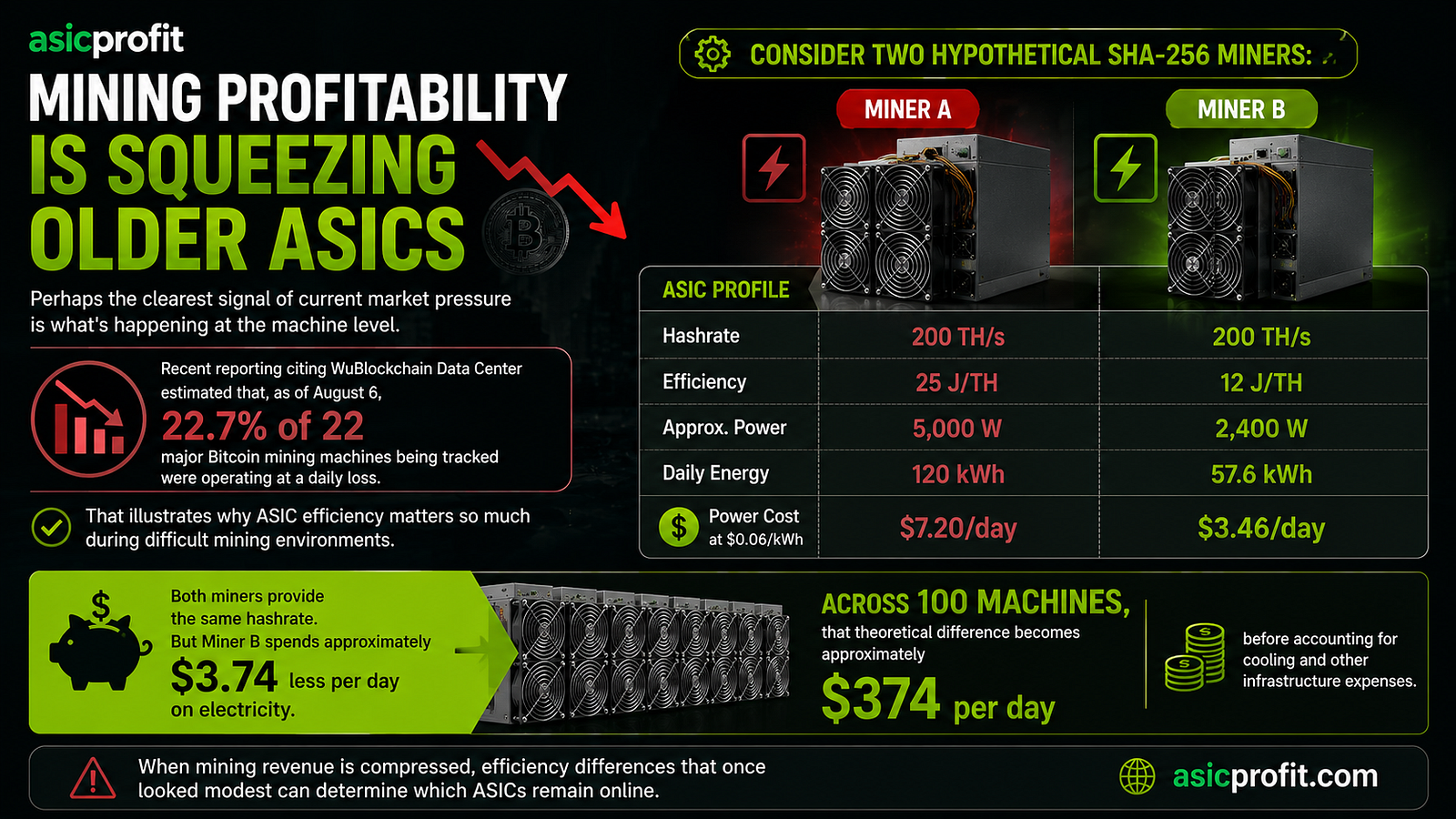
Both miners provide the same hashrate.
But Miner B spends approximately $3.74 less per day on electricity.
Across 100 machines, that theoretical difference becomes approximately $374 per day before accounting for cooling and other infrastructure expenses.
When mining revenue is compressed, efficiency differences that once looked modest can determine which ASICs remain online.
💰 Hashprice Is Becoming the Number Miners Cannot Ignore
Bitcoin price receives most of the attention from investors, but professional miners should also watch hashprice.
Hashprice essentially measures how much revenue miners can expect from a unit of hashrate.
When hashprice declines, each TH/s generates less revenue.
That means a Bitcoin price that appears relatively strong does not necessarily translate into strong mining economics. Network competition, block subsidies and transaction fees all affect the amount of revenue available to miners.
This is why profitability calculations should be refreshed regularly.
A machine that made financial sense several months ago may produce a completely different result today.
🧠 AI Is Changing the Economics of Mining Infrastructure
Another major trend in Bitcoin mining news is taking place outside Bitcoin itself.
AI companies need enormous quantities of electricity, land, substations, cooling infrastructure and data-center capacity.
Bitcoin miners already control many of those resources.
That overlap has created an increasingly important economic question:
Should every available megawatt continue powering ASIC miners?
Some mining companies are exploring AI and high-performance computing opportunities because the infrastructure surrounding a mining operation can potentially serve other forms of computing.
An ASIC cannot simply be converted into an AI GPU.
However, the power connection, land, cooling systems and data-center infrastructure around those ASICs may have value beyond Bitcoin mining.
This creates competition for capital and electricity inside the mining industry itself.
For miners, the result could eventually be a more dynamic market where electricity is allocated to whichever computing workload generates the strongest return.
🏭 Efficiency Is Becoming More Important Than Raw Hashrate
The latest market conditions reinforce a broader hardware trend: the industry is moving toward more efficient ASICs.
Higher hashrate still matters, but professional operators increasingly need to examine joules per terahash (J/TH) alongside headline TH/s.
Suppose two miners generate similar Bitcoin revenue.
If one consumes substantially less electricity, that machine has more room to survive:
- Bitcoin price declines
- Difficulty increases
- Transaction fees fall
- Electricity prices rise
- Hashprice contracts
Efficiency effectively gives miners a larger operating buffer.
That is particularly valuable in periods like the current market, when the profitability difference between newer and older ASIC generations becomes increasingly visible.
📊 What Should ASIC Miners Watch Right Now?
Looking at any one metric in isolation can create a misleading picture.
For example, falling difficulty may improve mining output, but a simultaneous decline in Bitcoin price could erase that advantage.
Similarly, an extremely efficient ASIC may still offer an unattractive ROI if the hardware purchase price is too high.
🧮 Why This Market Makes ROI Calculators More Important
Today’s environment demonstrates why miners should avoid using static profitability estimates.
Imagine calculating an ASIC’s ROI using today’s Bitcoin price, difficulty and electricity rate and assuming those numbers will remain unchanged for the next year.
That projection would almost certainly become outdated.
A better approach is to model several scenarios.
For example, calculate profitability at:
$0.04/kWh → $0.06/kWh → $0.08/kWh → $0.10/kWh
Then test how your results change when mining revenue rises or falls.
This gives miners a range of possible outcomes instead of one deceptively precise ROI number.
ASICProfit is designed to help miners compare these variables when evaluating hardware and potential mining investments.
🚀 What the Latest Bitcoin Mining News Means for ASIC Buyers
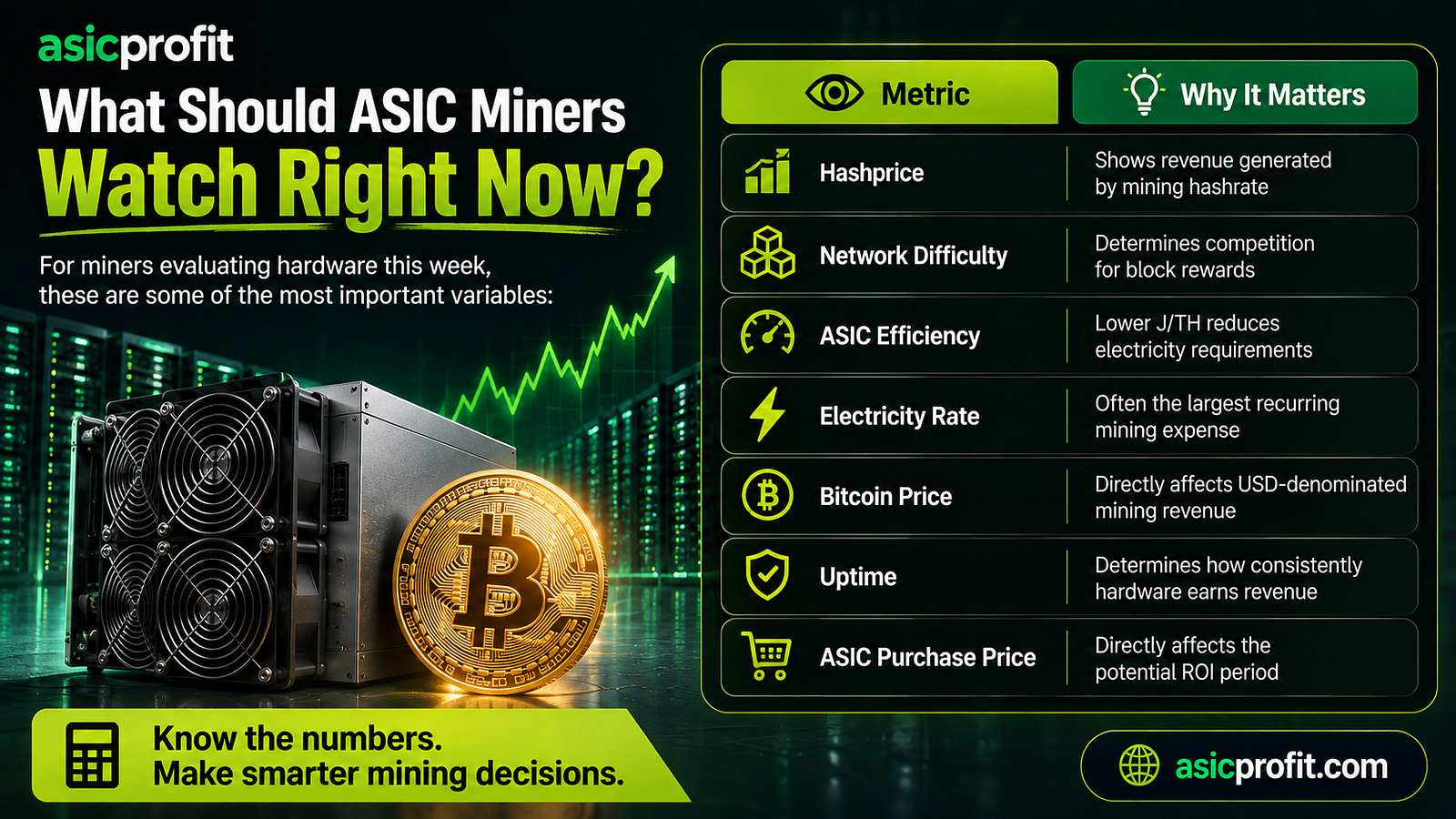
The current mining environment does not necessarily mean miners should stop investing in hardware.
It means hardware selection needs to become more disciplined.
Before purchasing an ASIC, consider three questions:
1. How efficient is the machine?
Lower J/TH generally provides more protection against electricity costs and declining mining revenue.
2. What is my real operating cost?
Do not calculate using someone else’s electricity rate. Include your own power price, hosting expenses and relevant operating costs.
3. What happens if conditions get worse?
Run downside scenarios before investing.
If a miner only looks attractive under perfect conditions, its risk profile may be significantly higher than the headline profitability figure suggests.
🔍 Conclusion
The latest Bitcoin mining news highlights an industry undergoing another economic adjustment.
Difficulty has fallen substantially from its peak, some ASIC models are struggling to remain profitable, and the growing AI infrastructure market is giving large mining operators another potential use for valuable power capacity.
For ASIC miners, the lesson is straightforward.
Efficiency, electricity cost and ROI discipline matter more when margins become tight.
The highest-hashrate machine is not automatically the best investment. What matters is how much revenue that hashrate produces relative to the cost of purchasing and operating the hardware.
As network conditions continue to change, miners should regularly recalculate profitability rather than relying on yesterday’s assumptions.
Calculate your ROI now with ASICProfit and evaluate your ASIC against current mining conditions before making your next investment.
#AsicProfit #BitcoinMining #ASICMining #Asicminer
Stay Connected
🎥 YouTube