
Bitcoin mining hardware is entering another efficiency race, and Bitdeer’s SEALMINER A4 Ultra Hydro 886 TH is one of the machines pushing performance below the 10 J/TH threshold.
Announced in April 2026 as the flagship hydro-cooled model in Bitdeer’s A4 series, the miner is rated at 886 TH/s, consumes approximately 8,372.7 watts, and delivers a stated power efficiency of 9.45 J/TH. Bitdeer says mass production and delivery are expected to begin in Q3 2026.
Those specifications are impressive, but hashrate alone does not determine whether an ASIC is a good investment. Electricity price, Bitcoin revenue, network difficulty, infrastructure costs, uptime, and hardware acquisition price ultimately determine profitability.
Here is what miners should evaluate before considering the A4 Ultra Hydro.
⚙️ SEALMINER A4 Ultra Hydro Specifications
The A4 generation uses Bitdeer’s proprietary SEAL04 technology and includes air- and hydro-cooled configurations. The Ultra Hydro occupies the highest-performance position in the lineup.
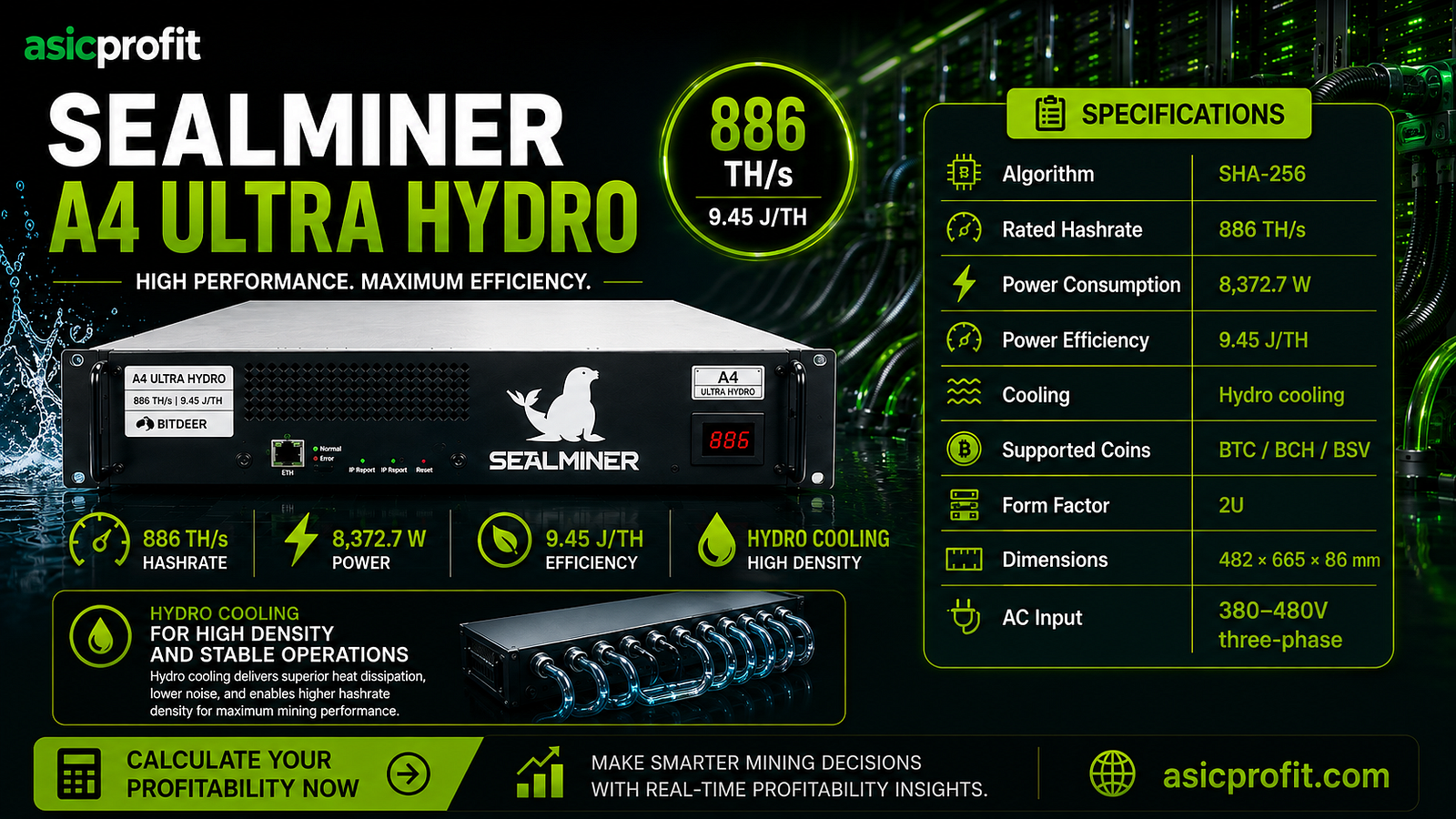
Bitdeer notes that actual performance can vary by approximately ±10% for hashrate and power consumption and ±5% for efficiency, an important consideration when building financial projections.
🚀 886 TH/s Changes the Density Equation
At 886 TH/s, a single A4 Ultra Hydro delivers close to 0.9 PH/s of SHA-256 computing power.
That level of density can be valuable for professional mining operations where rack space and infrastructure need to support as much productive hashrate as possible.
Ten units, for example, would provide a nominal 8.86 PH/s while drawing roughly 83.7 kW before accounting for pumps, heat exchangers and other facility overhead.
For large farms, this makes performance per rack and per square meter increasingly important — not simply performance per machine.
Bitdeer specifically positions the A4 Ultra Hydro for high-density environments and lists the hydro series in a compact 2U form factor.
⚡ Why 9.45 J/TH Matters for Profitability
The standout specification is arguably not 886 TH/s. It is 9.45 J/TH.
Joules per terahash measure how much energy is required to produce mining computation. Lower is better.
Bitdeer’s A4 Pro Hydro, for comparison, is rated at 680 TH/s and 10.9 J/TH, while the previous-generation A3 Pro Hydro is listed at 660 TH/s and 12.5 J/TH.
Improving efficiency becomes increasingly valuable as network competition rises because it lowers the electricity expense attached to every terahash produced.
Bitdeer illustrates that a 1.45 J/TH efficiency difference translates to approximately 1.45 kW less power per PH/s of normalized hashrate. Over large fleets, relatively small efficiency improvements can therefore become substantial operating-cost differences.
💰 What Does the A4 Ultra Hydro Cost to Run?
At its stated 8.3727 kW power consumption, the miner uses approximately:
8.3727 kW × 24 hours = 200.94 kWh per day
That makes electricity pricing critical.
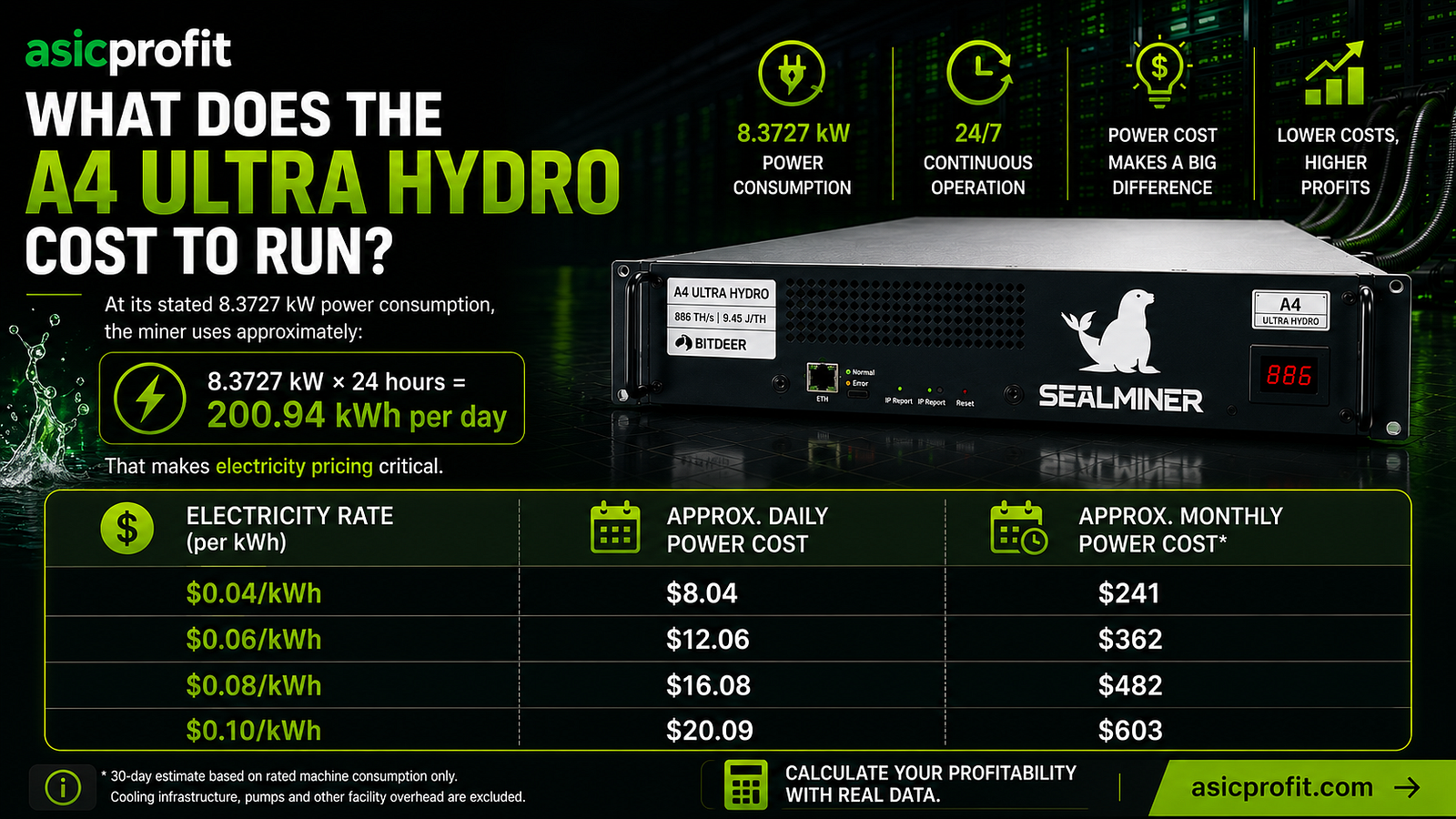
A miner paying $0.04/kWh therefore has a very different profitability profile from an operator paying $0.10/kWh — even though both are running exactly the same hardware.
This is why miners should calculate profitability using their actual electricity rate, rather than relying on generic online revenue estimates.
Use ASICProfit to model ASIC profitability against your own operating conditions.
🌊 Hydro Cooling Brings Advantages — and Infrastructure Requirements
The A4 Ultra Hydro is not designed as a typical plug-and-play home miner.
It requires hydro-cooling infrastructure and 380–480V three-phase AC input, immediately positioning it toward professionally managed mining facilities. Bitdeer says its hydro models are designed to operate across a 20°C–55°C environmental range and at near-silent noise levels.
Hydro cooling can provide efficient heat removal and enable much denser deployments, but operators also need to account for the complete system.
That includes pumps, piping, coolant circulation, heat exchangers, power distribution and maintenance procedures.
Consequently, comparing an 886 TH/s hydro miner directly with a conventional air-cooled ASIC based solely on machine price can give an incomplete picture.
Total cost of operation matters more than the miner specification sheet.
📊 Calculate Profitability Before Calculating ROI
This distinction is particularly important for the SEALMINER A4 Ultra Hydro 886 TH because Bitdeer’s product page currently lists the machine as “Stay tuned” rather than providing a public retail price.
Without a confirmed purchase price, a credible break-even period cannot yet be calculated.
Once pricing is available, miners should model several scenarios rather than relying on one ROI number.
Your calculation should include the hardware purchase price, electricity rate, facility or hosting costs, pool fees, expected uptime and infrastructure costs. Then stress-test those assumptions against changes in Bitcoin price and network difficulty.
Bitcoin mining revenue is variable. Today’s projected payback period is not a guarantee of tomorrow’s results.
📈 Network Difficulty Can Change the Picture
A more efficient ASIC provides miners with additional operating margin, but it does not remove market risk.
If more efficient equipment enters the network, total hashrate can rise. As difficulty adjusts upward, an individual miner can earn less BTC for the same amount of hashrate.
That creates an important dynamic: new ASIC efficiency helps miners compete with increasing difficulty, but widespread deployment of efficient ASICs can itself contribute to stronger network competition.
Miners should therefore periodically recalculate their projections rather than treating ROI as a fixed number.
You can also follow broader cryptocurrency market movements through CoinMarketCap and compare those conditions against your ASIC profitability assumptions.
🧮 Where ASICProfit Fits Into the Decision
The purpose of a profitability calculator is not to predict exactly what an ASIC will earn years into the future.
It is to help miners understand how different assumptions change the economics.
With ASICProfit’s mining tools, miners can evaluate hardware against variables such as hashrate, power consumption and electricity pricing before committing capital.
That becomes especially useful with a machine like the A4 Ultra Hydro because its enormous hashrate is paired with equally significant infrastructure requirements.
A professional operator should ask a more useful question than “How much can 886 TH/s earn today?”
The better question is:
“How profitable could 886 TH/s be under my actual operating conditions?”
🔍 Conclusion
The Bitdeer SEALMINER A4 Ultra Hydro 886 TH represents a significant step in high-density SHA-256 mining hardware.
Its combination of 886 TH/s hashrate and 9.45 J/TH efficiency puts the focus exactly where the modern mining industry is heading: more computing power from every unit of electricity consumed.
But impressive specifications do not automatically equal impressive ROI.
Electricity price, hardware cost, hydro infrastructure, network difficulty, Bitcoin price and uptime will determine whether the machine makes financial sense for a particular operation.
Before investing, model multiple scenarios and understand how quickly your projected return changes when those variables move.
Calculate your ROI now with ASICProfit and make your next ASIC decision based on numbers — not assumptions.
#AsicProfit #BitcoinMining #ASICMining #Asicminer
Stay Connected
🎥 YouTube