
Today’s ASIC Mining Update: Efficiency Still Leads the Market
ASIC mining conditions are showing modest signs of improvement, but profitability remains highly dependent on efficiency, electricity rates, and reliable operation.
Recent market activity suggests that Bitcoin mining revenue has strengthened slightly compared with earlier periods. Bitcoin’s price, transaction fees, network hashrate, and hashprice have all shown improvement, creating a healthier environment for miners operating modern equipment.
However, improving revenue does not mean every ASIC miner is suddenly profitable. As more mining machines return online, competition increases. Older hardware with high energy consumption may continue struggling, particularly in locations with expensive electricity.
Today’s market is rewarding miners who focus on output per watt, uptime, security, and careful cost control.
With AsicProfit, miners can compare ASIC hardware, estimate energy expenses, and calculate potential ROI before purchasing or expanding a mining operation.
Mining Revenue Is Showing Modest Improvement
One of the more positive developments in ASIC mining today is the recent improvement in Bitcoin mining revenue conditions.
Hashprice, which estimates the daily revenue generated by a unit of Bitcoin mining hashrate, has moved higher alongside Bitcoin’s market price and transaction fees. This gives active miners a little more revenue for the computing power they provide.
A stronger hashprice can improve gross earnings, but it should not be confused with guaranteed profit. Every mining operation still needs to subtract:
- Electricity expenses
- Mining pool fees
- Cooling costs
- Hosting charges
- Maintenance and repair costs
- Downtime losses
A miner may appear profitable based on daily revenue while producing a much smaller return after operating expenses are included.
That is why miners should calculate net profitability rather than relying only on revenue figures.
Network Competition Is Returning
The Bitcoin network hashrate has also been recovering.
A rising network hashrate usually means more mining equipment is operating and competing for the same block rewards. Some machines that were previously shut down may be returning as revenue conditions improve.
This can be encouraging because it reflects renewed confidence among mining operators. However, it also means competition is increasing.
When more hashrate joins the network, Bitcoin difficulty may eventually adjust upward. A higher difficulty level reduces the amount of Bitcoin an individual miner can expect to earn from the same amount of hashrate.
This creates a cycle miners should understand:
- Hashprice improves.
- More ASIC miners return online.
- Network hashrate rises.
- Mining difficulty may increase.
- Revenue per terahash may become tighter again.
Because these conditions change regularly, ASIC buyers should not base a purchase on one strong day or week. A better strategy is to test profitability under several price, difficulty, and electricity scenarios.
Efficient ASIC Miners Continue to Win
The strongest trend in ASIC mining today remains hardware efficiency.
Modern Bitcoin miners are increasingly evaluated by their joules-per-terahash rating, commonly written as J/TH. This figure shows how much energy a miner needs to produce one terahash of computing power.
Lower J/TH means better energy efficiency.
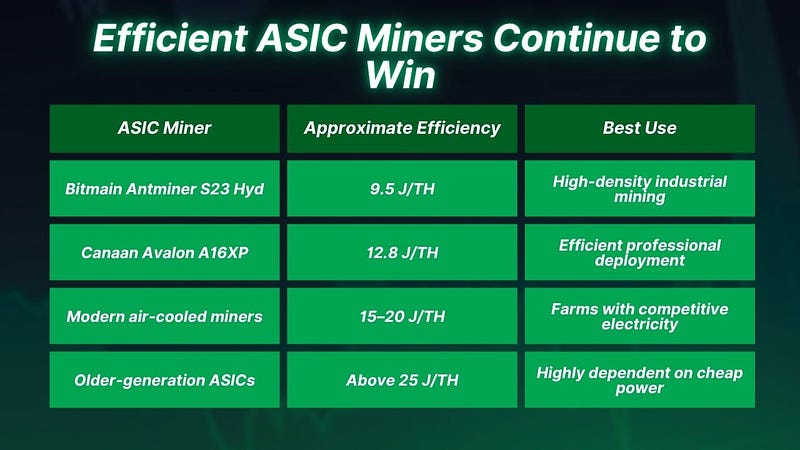
The Bitmain Antminer S23 Hyd represents the direction of new-generation hardware. Its efficiency allows operators to produce more hashrate from a fixed amount of electrical capacity.
However, this machine also requires hydro-cooling infrastructure. The hardware specification alone does not include the cost of pumps, plumbing, heat exchangers, water management, and facility preparation.
The best ASIC is not always the machine with the lowest J/TH. It is the machine that fits the operator’s power supply, cooling system, budget, and long-term strategy.
Compare available machines here:
Electricity Still Determines Real Profit
Even when hashprice improves, electricity remains the largest recurring cost for most ASIC miners.
Consider a miner consuming 3.5 kW and operating continuously.
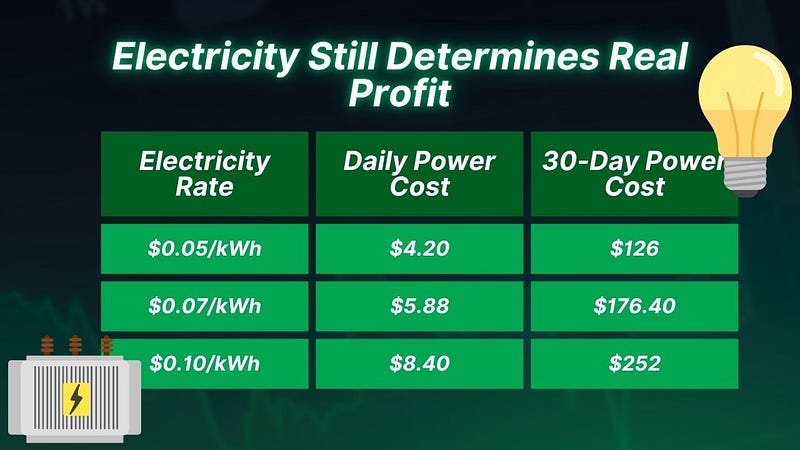
The same miner produces the same hashrate at every electricity rate. The difference is how much revenue the operator keeps.
At $0.10 per kWh, the machine costs approximately $126 more each month to operate than it would at $0.05 per kWh. Across ten miners, that difference becomes roughly $1,260 per month.
This is why an efficient machine at a competitive electricity rate can outperform a higher-hashrate ASIC running with expensive power.
Miners should calculate electricity costs before ordering hardware, not after the machine arrives.
Estimate your operating expenses with the AsicProfit calculator:
https://asicprofit.com/calculator
Large Mining Operations Are Optimizing Their Fleets
Many professional mining companies are no longer focused only on adding as many ASIC miners as possible.
Instead, operators are reviewing how much hashrate they can produce from their existing electrical capacity. Older machines may be replaced by newer models that generate more computing power while consuming the same or less electricity.
Current optimization strategies include:
- Replacing inefficient ASIC miners
- Improving cooling and airflow
- Reducing rejected shares
- Automating machine monitoring
- Negotiating better electricity agreements
- Repairing machines faster
- Increasing uptime
This approach can improve total hashrate without requiring an equally large increase in facility power.
For example, replacing a fleet operating above 25 J/TH with machines closer to 15 J/TH can significantly increase hashrate density. The exact benefit depends on the miners, infrastructure, and electrical limits of the site.
Firmware Security Is Becoming More Important
ASIC mining security is receiving more attention as operators depend increasingly on remote dashboards, custom firmware, and internet-connected devices.
Firmware controls key parts of an ASIC miner, including performance settings, fan behavior, pool connections, and system access. Installing firmware from an untrusted source can expose a machine to unauthorized control or hidden mining activity.
Operators should follow several basic precautions:
- Download firmware from official or verified sources
- Confirm that the update matches the exact miner model
- Replace default usernames and passwords
- Restrict remote access
- Monitor pool and wallet settings
- Separate ASIC miners from sensitive business networks
- Avoid firmware promising unrealistic performance gains
Third-party firmware may offer useful tuning features, but operators should understand the risks before deploying it across an entire fleet.
One compromised miner is a problem. One compromised firmware image installed on hundreds of machines can become a serious operational loss.
What ASIC Miners Should Do Today
Today’s market does not require miners to make rushed decisions. It provides an opportunity to review whether their equipment remains competitive.
Existing operators should compare expected hashrate with actual pool-side performance. A machine rated at 200 TH/s may produce less revenue if overheating, internet problems, rejected shares, or downtime reduce its average output.
Potential buyers should calculate profitability at several electricity rates and market conditions. An ASIC purchase should not depend entirely on Bitcoin remaining at one price or mining difficulty staying unchanged.
Miners should also compare:
- Hardware purchase price
- Energy efficiency
- Cooling requirements
- Hosting expenses
- Expected uptime
- Pool fees
- Repair availability
- Estimated payback period
AsicProfit can help turn these variables into a clearer hardware comparison.
Conclusion
The latest ASIC mining update is cautiously positive. Mining revenue conditions have improved slightly, hashprice has strengthened, and more computing power appears to be returning to the Bitcoin network.
At the same time, recovering hashrate means competition is increasing. Future difficulty adjustments may reduce some of the current improvement, particularly for miners running older and less efficient equipment.
The strongest operators today are not simply purchasing the highest-hashrate ASICs. They are combining efficient hardware with affordable electricity, secure firmware, reliable cooling, and consistent uptime.
Before purchasing a new miner or expanding an existing fleet, use AsicProfit to compare current ASIC models, estimate electricity expenses, and calculate potential returns under realistic conditions.
Calculate your ROI now: https://asicprofit.com
#AsicProfit #ASICMining #BitcoinMining #AsicMiner #MiningProfitability
Stay Connected
🎥 YouTube